

Blog Vous

Life Science: Content on Fetal Medicine and Human Reproduction by Dr. Andre Miyague and Dr. Danielle Miyague.

Author: Dr. Andre Miyague

mãos de gestante segurando uma imagem de ultrassom

Tetralogy of Fallot: what does this diagnosis mean during pregnancy?

Receiving the news that there is a heart defect in the baby during pregnancy often generates many doubts and insecurities. Among the congenital heart defects that can be identified prenatally is... Fallot's Tetralogy, a heart condition that is relatively well-known in medicine, but poorly understood by the general public.

In this article, I explain What is Tetralogy of Fallot, how can it be identified during pregnancy, and why is prenatal diagnosis so important for planning the baby's care?.

The goal is to transform a complex medical term into understandable information, without alarmism and always based on evidence.


READ MORE
Imagem ilustrativa de um feto

Agenesis of the Corpus Callosum: What does this diagnosis mean during pregnancy?

Receiving a different diagnosis during pregnancy often generates many doubts, insecurities, and, naturally, fear. When the term involved is agenesis of the corpus callosum, However, this feeling can be even more intense, after all, we are talking about the development of the baby's brain.

This article was written to explain, in a way clear, responsible and evidence-based, What is agenesis of the corpus callosum, how can it be identified during pregnancy, what are the possible outcomes, and, most importantly, What is the role of fetal medicine in this context?.

If you have received this diagnosis or are investigating this possibility, know this from the start: Quality information helps transform anxiety into care and planning..

READ MORE
Obstetra e médico fetal analisam o ultrassom em conjunto para oferecer cuidado integral à gestante e ao bebê.

The relationship between the Obstetrician and the Fetal Medicine specialist: two areas that complement each other in caring for the same life.

When a pregnant woman arrives at the doctor's office for the first time, she brings with her a mixture of joy, expectation, and worry. And it is precisely at this beginning that a common question arises: What is the difference between an obstetrician and a doctor specializing in fetal medicine?

They both participate in the same pregnancy, care for the same baby, and walk together, but each with a very specific role.

It is about this partnership that I want to talk here. To explain how we complement each other, why we work side by side, and how this relationship ensures greater safety, diagnostic accuracy, and peace of mind for the family.

READ MORE
Ultrassom ilustrado de bebê no útero, representando o diagnóstico e acompanhamento de tumores fetais com esperança e cuidado.

Fetal tumors: when diagnosis is not a death sentence.

Receiving the news of a "tumor in the baby" while still in the womb naturally evokes fear and insecurity. It's a powerful word, loaded with meaning and often immediately associated with something malignant.

But it's not always like that.
In fetal medicine, many tumors diagnosed during pregnancy are benign and can be safely monitored until birth.

In this article, I want to clearly explain what fetal tumors are, where they usually appear, what risks are involved, and, most importantly, how we can best care for them with responsibility, planning, and hope.

READ MORE
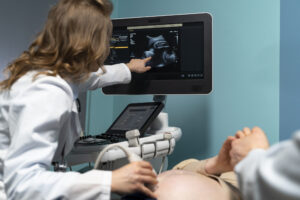
Gestante em consulta médica com profissional da saúde mostrando imagem de ultrassom em tela, em ambiente acolhedor e calmo.

First-trimester ultrasound: what does an increased-risk result mean?

Receiving a "high-risk" result during a first-trimester ultrasound can undoubtedly be one of the most challenging moments of prenatal care. It's a term that scares people, generates doubts, and often ends up bringing more anxiety than clarity. But that's precisely why I decided to write this text.

Because before anything else, it's important to understand what this result actually means.

READ MORE
Dr. André Miyague palestrante na SOGIPA

Fetal Growth Restriction: when the baby stops growing... even at a normal weight.

Folks, when we talk about Fetal Growth Restriction, it's very common to only think about that visibly small, thin baby with a lower than expected weight. But the truth is that the case isn't always that obvious.

I had the opportunity to speak about this topic at the 6th Ultrasound Conference of the Brazilian Society of Ultrasound in Paraná – SOPRUS 2025, here in Curitiba. And wow… it was special to be able to share this subject with colleagues, a subject that is increasingly appearing in our daily practice.

Today, I want to share with you some important points from the lecture. Because understanding how fetal growth restriction (FGR) works—especially late-stage FGR—can completely change the outcome of a pregnancy.

READ MORE
Ilustração mostrando o desenvolvimento fetal em diferentes trimestres da gravidez.

Fetal development from the first to the third trimester

Pregnancy is one of the most transformative and exciting experiences in a family's life. From the moment the test is positive until birth, the baby undergoes an incredible process of growth and development inside the womb. As a specialist in Fetal Medicine, my role is to monitor and evaluate each stage of this journey, ensuring the health and well-being of the fetus and bringing peace of mind to the parents.

In this article, I will explain in detail what happens in each trimester of pregnancy, highlighting the most important milestones in fetal development and the essential tests at each stage.

READ MORE
Imagem de um ultrassom morfológico sendo realizado em uma gestante

Everything about the morphological ultrasound: the essential exam for your baby's health.

If you are pregnant, you have probably already heard about the morphological ultrasound. This exam is one of the most important steps in prenatal care, as it helps to thoroughly assess the baby's health and even identify if your pregnancy can be considered high-risk. Today, I'm going to explain everything you need to know about the procedure, from when to have it done to what we can find out from it.

READ MORE
Ilustração de curvas de crescimento fetal e percentis, explicando o acompanhamento do desenvolvimento do bebê durante a gestação.

Restrição de crescimento fetal: o que é e como acompanhar o desenvolvimento do seu bebê

A gravidez é uma fase cheia de descobertas e emoções. Uma das grandes preocupações dos pais é o crescimento saudável do bebê. Uma maneira importante de acompanhar esse desenvolvimento é entender conceitos como o percentil e as curvas de crescimento. Além disso, é essencial saber identificar casos em que o bebê não está crescendo como esperado, o que chamamos de Restrição de Crescimento Fetal (RCF). 

Neste artigo, vou explicar de forma simples e clara o que significam esses termos, como o percentil, o que é um crescimento normal, e as diferenças entre a restrição de crescimento fetal precoce e tardia.

READ MORE
Search